
Denmark has long been regarded as a pioneer in water management, yet the ecological condition of its coastal waters remains one of the country's greatest environmental challenges. Under the European Union Water Framework Directive (WFD), Member States are required to achieve "good ecological status" for all surface waters by 2027. Despite decades of action, fewer than 10% of Danish coastal waters currently meet this target, highlighting the gap between environmental ambition and ecological reality.
The primary driver of this poor condition is nutrient pollution from agriculture. Denmark is one of Europe's most intensively farmed countries, with approximately 60% of its land used for agriculture. Combined with extensive drainage systems and relatively flat topography, this allows nitrogen and phosphorus from fertilizers and manure to be transported into rivers, fjords, and coastal waters. Once these nutrients reach the marine environment, they stimulate excessive algal growth, leading to eutrophication, oxygen depletion, loss of eelgrass meadows, declining biodiversity, and degradation of benthic habitats.
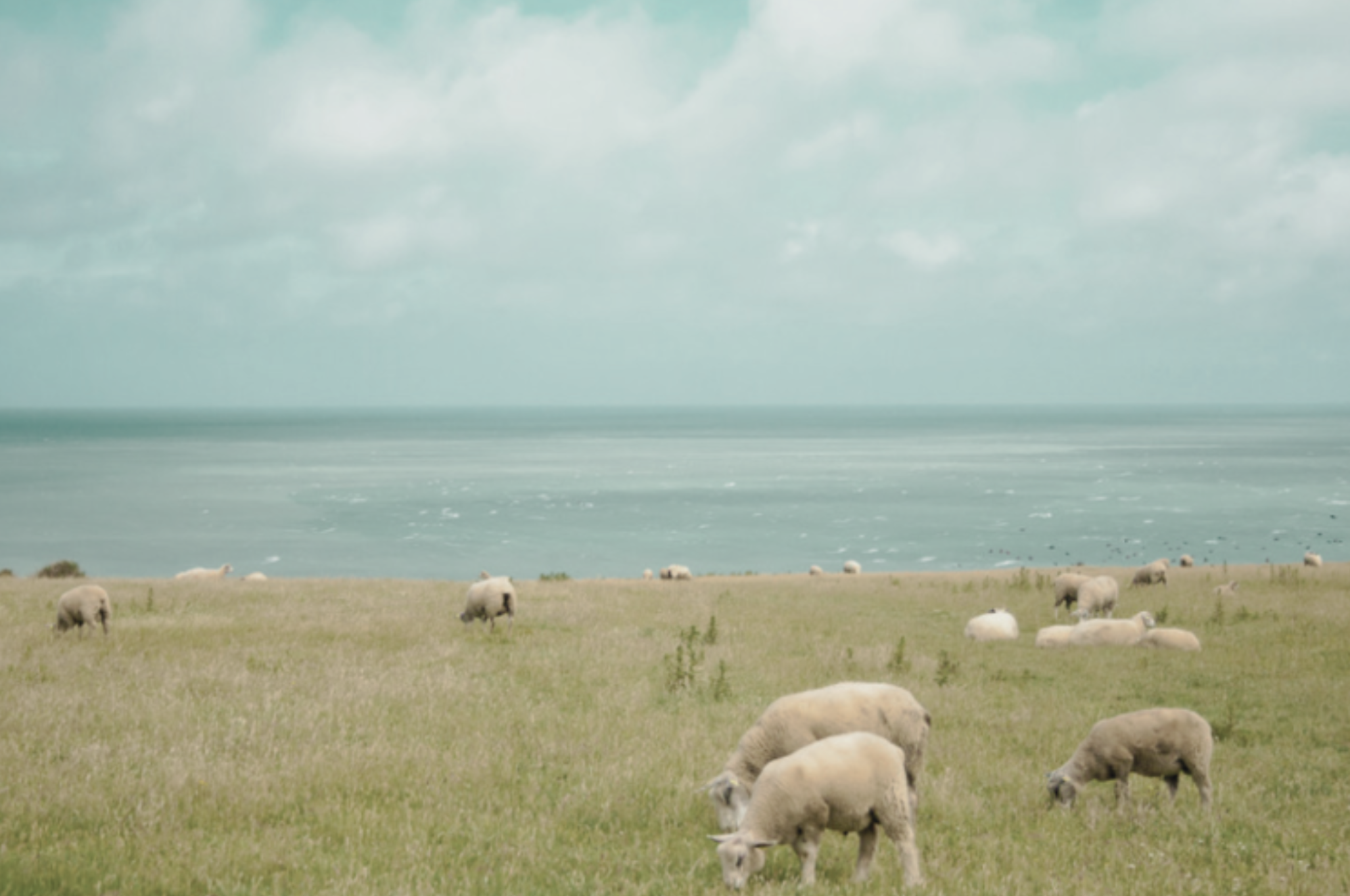
Recent research examining 109 Danish coastal water bodies between 1980 and 2023 found that despite the efforts to reduce the runoff, eutrophication still affects large areas of the country. While nutrient concentrations have decreased and water clarity has improved in some places, the overall recovery of marine ecosystems has slowed since the early 2000s. Important indicators such as eelgrass depth limits and bottom-water oxygen levels have shown little improvement in many areas.
The map below extracted from GIS information from the Danish Environmental Protection Agency shows the overall ecological condition of coastal waters from 2021, based on several quality measures with the nitrogen load on land. The poor condition is attributed mainly due to excessive phosphorus and nitrogen load from agricultural farming. Recent efforts to clean up the coastal waters have shown some levels of improvement in water quality over the years. However, none of the coastal water bodies are deemed to be in excellent ecological condition.
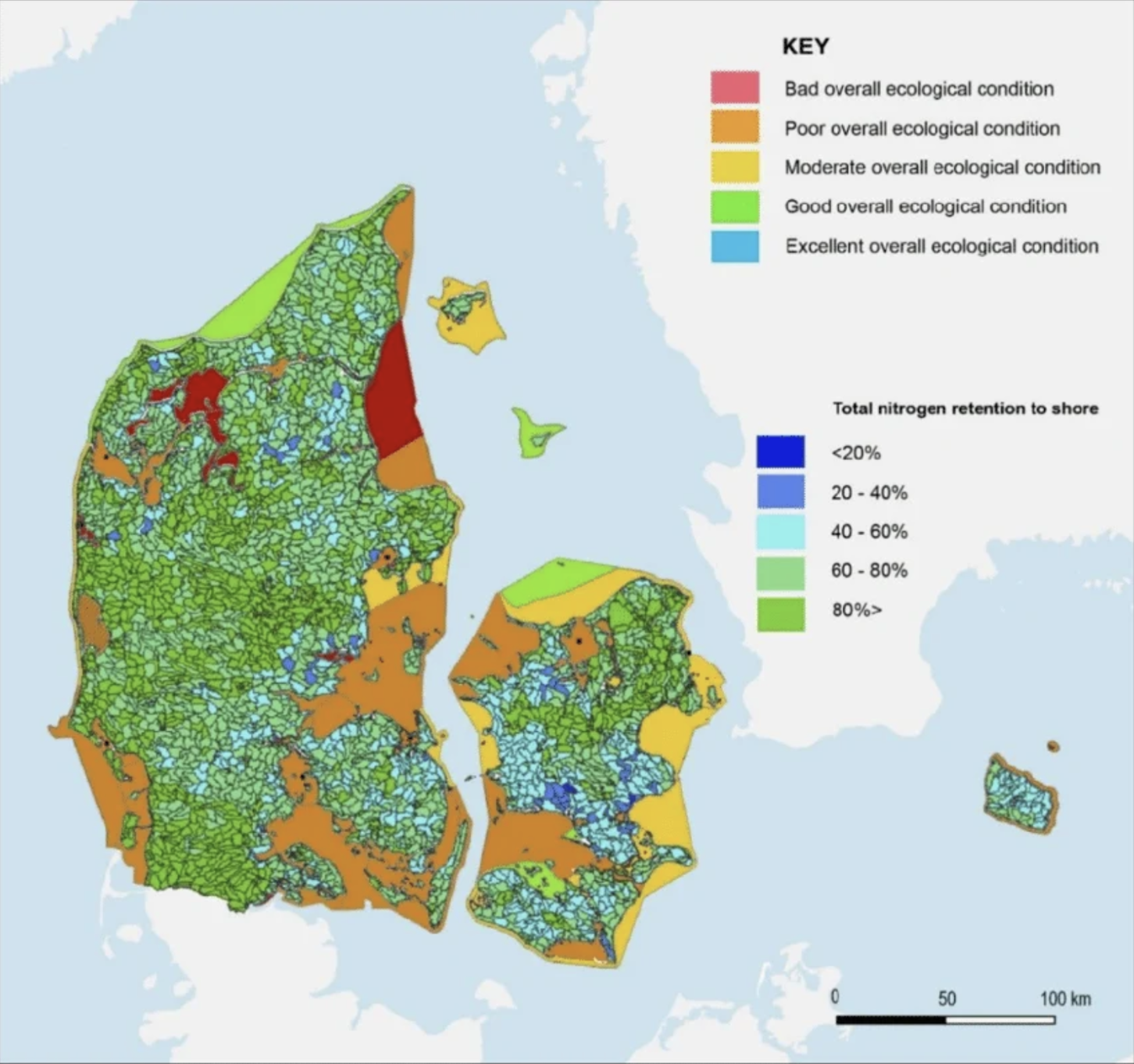
Source: Lincoln Planning Review (2021)
One of the main challenges of managing agricultural runoff is its classification as a nonpoint source of pollution which is a diffuse form of contamination that does not originate from a single, or exact location, making it difficult to trace back to a precise origin. Therefore it is much more difficult to regulate compared to point sources like factories. Additionally, another main struggle is reconciling the protection of the marine environments with the centrality of agriculture to the Danish economy. The government faces the serious challenge of having to comply with environmental legislation while simultaneously maintaining high agricultural production levels.
In that context, efforts to mitigate the environmental impact of agricultural runoff have been made by the country in an attempt to balance coastal environment protection and agricultural development. Actions to increase water quality began in the 1980s following growing scientific evidence of widespread eutrophication.
The first Action Plan for the Aquatic Environment (Vandmiljøplan I) was adopted in 1987 after severe oxygen depletion events and introduced measures to reduce nutrient losses from agriculture and wastewater treatment. Two additional action plans followed during the 1990s and early 2000s, progressively tightening fertilizer management, improving manure handling, restoring wetlands, and upgrading wastewater treatment plants.These measures produced relevant results. Since the early 1990s, nitrogen and phosphorus loads transported to Danish coastal waters have been reduced substantially. Restored and newly constructed wetlands, buffer strips, improved drainage systems, and catch crops have helped intercept nutrients before they reach rivers and fjords. However, although nutrient inputs have declined, ecological recovery has proven much slower than expected.
An important policy change occurred in 2016 with the adoption of the Agricultural Package (Landbrugspakken). Rather than applying uniform national fertilizer restrictions, Denmark introduced a more targeted approach, allowing greater nitrogen application in less environmentally sensitive areas while focusing mitigation measures in vulnerable catchments. This reflected a broader attempt to balance agricultural productivity with environmental protection. Although the package included compensatory measures such as additional wetlands and targeted nutrient reduction projects, subsequent scientific assessments indicate that improvements in coastal water quality have been modest. Many researchers argue that the relaxation of fertilizer restrictions has reduced the pace of nutrient reductions, making it more difficult for Denmark to meet the ecological objectives established by the Water Framework Directive.
The condition of Danish coastal waters varies considerably across the country but most degraded environments are generally enclosed fjords and estuaries, where water exchange with the open sea is limited. Areas such as Limfjorden, Mariager Fjord, Odense Fjord, Roskilde Fjord, and parts of the inner Danish fjords frequently experience oxygen depletion during summer months due to high nutrient inputs and restricted water circulation.
The west coast of Jutland, facing the North Sea, generally has the best water quality in Denmark. These open coastal waters benefit from strong tidal currents and continuous exchange with the North Sea, which dilute nutrient concentrations and reduce the likelihood of prolonged oxygen depletion. While rivers still transport nutrients from agricultural land, the high water turnover makes these ecosystems more resilient.
In contrast, the eastern coast of Jutland and the inner Danish waters, including Limfjorden, Aarhus Bay, Horsens Fjord, and Vejle Fjord, experience much greater environmental pressure. These semi-enclosed waters receive high nutrient loads from surrounding agricultural catchments and have slower water circulation, making them particularly vulnerable to eutrophication and seasonal oxygen depletion. Limfjorden has long been considered one of Denmark's most nutrient-impacted marine areas, with recurring algal blooms and hypoxic events.
Around Zealand (Sjælland), several fjords also remain in poor ecological condition. Roskilde Fjord, Isefjord, and Holbæk Fjord are strongly influenced by nutrient runoff from intensive agriculture and urban catchments. Their limited water exchange contributes to poor water clarity, declining eelgrass meadows, and frequent summer oxygen depletion. South of Zealand, coastal waters connected to the western Baltic Sea also continue to experience eutrophication, although conditions vary depending on local hydrology and nutrient inputs.
The southern Danish islands, including Funen (Fyn) and Lolland-Falster, are surrounded by numerous small bays and fjords where nutrient retention is high. Coastal waters such as Odense Fjord have shown some improvement following nutrient reduction measures but continue to fall short of the ecological objectives established under the EU Water Framework Directive. Across the country, eelgrass recovery has been slow, and many coastal ecosystems continue to show only limited improvement despite reductions in nutrient loading.
Denmark's approach to protecting coastal waters has gradually evolved from regulating fertilizer use to managing entire landscapes. While earlier policies focused on nationwide restrictions on agricultural nutrient inputs, current strategies increasingly rely on targeted nitrogen reductions, wetland restoration, afforestation, and catchment-scale planning through the River Basin Management Plans and the Green Tripartite Agreement. Despite these efforts, political challenges remain. Policymakers face the issue of balancing the economic importance of the agricultural sector with the need to meet legally binding EU water quality targets. At the same time, climate change is making coastal ecosystems more vulnerable to eutrophication, meaning that achieving good ecological status will require both stronger nutrient reductions and continued long-term restoration efforts.
Therefore the future of Denmark's coastal waters will depend not only on continued scientific monitoring and targeted nutrient reduction measures, but also on political decisions and effective implementation of the current coastal protection framework. For citizens, staying informed about these policies and holding decision-makers accountable is an essential part of ensuring that future generations inherit healthier seas than those of today.